Lower Back Pain When Bending Forward: Causes and What Helps
Bending isn't the enemy. Why your back hurts when you bend, what scans really show, and how to get comfortable bending again.
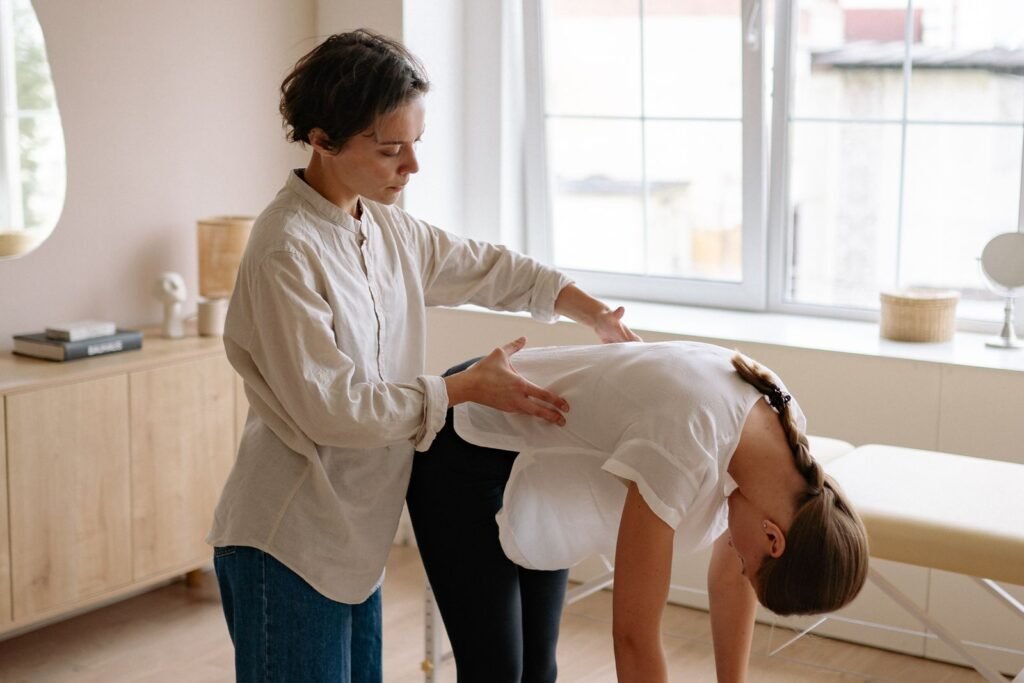
Lower back pain when you bend forward is very common, and in most people it comes from the muscles, joints and discs of the lower back being sensitive rather than from damage. It often follows a period of sitting, lifting, poor sleep or stress, and it usually settles with time and the right kind of movement. Research doesn’t support the idea that bending your back is dangerous: a review of lifting studies found that how much people rounded their back while lifting didn’t predict who developed back pain. Gradually getting used to bending again, with exercise and reassurance, tends to work better than avoiding it. A few warning signs need a doctor straight away.
The short version
- It’s usually not damage. Pain on bending is most often a sensitive back, not a structural injury.
- Bending isn’t the enemy. A review of lifting studies found that rounding the back while lifting wasn’t a risk factor for back pain.
- Scan findings are common without pain. Disc bulges show up in about 30% of pain-free 20-year-olds and most pain-free older adults.
- Movement helps more than avoidance. In a large trial, a physiotherapy approach that rebuilt confidence in movement gave large, lasting improvements.
- Know the red flags. Numbness around the groin, new bladder or bowel problems, or leg weakness need urgent care.
Why does my lower back hurt when I bend forward?
Bending forward loads the muscles along the spine, stretches the tissues at the back of the lower spine, and increases pressure on the discs. When these structures are sensitive, that load is felt as pain, a pulling feeling or a catch. Sensitive doesn’t mean damaged. After a long day at a desk, a sudden lift, a bad night’s sleep or a stressful week, the back’s warning system can become more protective, and ordinary movements like putting on shoes or loading the dishwasher start to hurt.
Common patterns include:
- Muscle guarding: the back muscles tighten to protect the area, so bending feels stiff and sore, especially first thing in the morning.
- Disc-related pain: pain that’s worse with sitting and bending, sometimes with pain into the buttock or leg.
- Joint and ligament sensitivity: a sharp catch at a certain point in the movement, often on one side.
- Tight hips and hamstrings: if the hips don’t bend much, the lower back does more of the work.
If your pain is worse in the morning and eases as you move, our guide to a stiff back in the morning covers that pattern in detail.
Is it bad to bend your back?
Many people are told to keep a “straight back” and never round it. The research is less certain than that advice suggests. A 2020 systematic review looked at whether rounding the lower back while lifting was linked to back pain. It found low-quality evidence that greater lumbar flexion during lifting was not a risk factor for back pain starting or continuing, and didn’t separate people with back pain from those without. In some of the studies, people with back pain actually bent their lower back slightly less when lifting.1
That doesn’t mean heavy, careless lifting is a good idea. It means your spine is built to bend, and protecting it by avoiding all bending can keep it stiff and sensitive for longer.
What if a scan shows a disc bulge?
Scans often find changes that sound worrying but are common in people with no pain at all. A review of 33 studies covering 3,110 people without back pain found disc bulges in 30% of 20-year-olds, rising to 84% of 80-year-olds, and disc degeneration in 37% of 20-year-olds, rising to 96% of 80-year-olds. The authors concluded that many of these findings are likely part of normal ageing.2
Most people with back pain don’t need a scan. If you’ve been told you have a slipped disc, our guide to slipped disc symptoms and recovery explains what that really means.
Back pain when bending: common causes compared
| Muscle or joint sensitivity | Disc-related pain | Sciatica | |
|---|---|---|---|
| Where you feel it | Lower back, one or both sides | Lower back, sometimes buttock | Below the knee, often into the foot |
| What makes it worse | Bending, twisting, staying still too long | Sitting, bending, coughing or sneezing | Sitting, bending, sometimes walking |
| Other signs | Stiffness that eases with movement | Morning stiffness, pain on getting up from a chair | Tingling, numbness or weakness in the leg |
| Usual outlook | Often settles in days to weeks | Usually improves over weeks | Often improves over weeks to months |
Not sure if your pain is sciatica? See sciatica or lower back pain: how to tell.
What helps back pain when bending?
Keep moving, and rebuild bending gradually
NICE, the UK’s guideline body, recommends exercise as a core part of managing low back pain, and says manual therapy should only be used alongside exercise, not on its own.3 For bending pain, that usually means starting with movements that feel manageable and slowly building up, rather than waiting for the pain to disappear before you bend again.
Change how you think about the pain
A large Australian trial called RESTORE tested cognitive functional therapy, a physiotherapy approach that helps people understand their pain, reduce fear of movement and practise the movements they’ve been avoiding, often including bending. In 492 people with long-term disabling back pain, it reduced activity limitation much more than usual care at 13 weeks, with similar benefits at a year.4 At a 3-year follow-up, people who’d had the treatment still had less activity limitation and less pain than the usual care group.5
A gentle way to practise bending again
- Stand tall with your feet hip-width apart and your knees soft.
- Breathe out and let your head, then your upper back, curl down slowly, sliding your hands down your thighs. Only go as far as feels comfortable.
- Pause and breathe for a couple of slow breaths. Let your back muscles soften rather than brace.
- Roll back up slowly, using your hands on your thighs for support if you need to.
- Repeat 5 to 8 times, a few times a day, going a little further as it gets easier.
Some discomfort is fine. Stop if the pain spreads down your leg, or if it’s much worse afterwards and doesn’t settle within a day.
Other things that help
- Break up sitting: long periods of sitting often make bending pain worse. Our guide to lower back pain from sitting explains why.
- Use your hips: when lifting something heavy, bend at the hips and knees and keep the load close. For everyday bending, you don’t need to be rigid.
- Stay generally active: walking, swimming and strengthening all help. See our exercises for lower back pain.
- Look at the bigger picture: poor sleep, stress and worry can all make pain more sensitive, and they matter as much as posture.
When to see a physiotherapist
See a physiotherapist if bending pain hasn’t improved after a couple of weeks, keeps coming back, is stopping you from working or exercising, or if you’re worried about what’s causing it. Recurring pain often has a pattern behind it, which our article on why back pain keeps coming back explores.
How physiotherapy at Somatic Recovery helps
Shubhangii Gaikwaad, a DHA-licensed physiotherapist, will ask about when your pain started and what makes it better or worse, watch how you bend and move, and check for any signs that need a doctor. Treatment usually combines graded bending and strengthening exercises, hands-on treatment where it helps, dry needling for tight muscles if it suits you, and practical advice for work and home. Read more about our back pain treatment in Dubai.
Get urgent medical help (call 998 in the UAE) if you have back pain with
- Numbness or tingling around your genitals, buttocks or inner thighs
- New difficulty passing urine, loss of bladder or bowel control
- Weakness in one or both legs that is getting worse
- Fever, feeling very unwell, or pain after a fall or accident
Also see a doctor for back pain with unexplained weight loss, a history of cancer, or pain that is severe at night and not eased by rest. Our guide to back pain red flags has more detail.
Frequently asked questions
Why does my lower back hurt when I bend over?
Usually because the muscles, joints or discs of the lower back have become sensitive, often after sitting, lifting, poor sleep or stress. Bending loads those tissues, so you feel pain, but in most cases it doesn’t mean anything is damaged.
Should I avoid bending if my back hurts?
Not completely. Research doesn’t show that rounding the back is dangerous, and avoiding bending can keep the back stiff and sensitive. Start with gentle, comfortable bending and build up gradually.
Is pain when bending forward a sign of a disc problem?
It can be, but not always. Disc-related pain is often worse with sitting and bending. Disc bulges are also common in people with no pain at all, so a physiotherapist’s assessment is more useful than guessing.
How long does back pain from bending take to go away?
Many episodes settle within days to a few weeks with gentle activity. If it hasn’t improved after a couple of weeks, keeps coming back or is limiting your daily life, see a physiotherapist.
When is back pain when bending serious?
Get urgent help for numbness around the groin or buttocks, new bladder or bowel problems, worsening leg weakness, or back pain with fever or after a fall. In the UAE, call 998.
References
- Saraceni N, Kent P, Ng L, Campbell A, Straker L, O’Sullivan P. To flex or not to flex? Is there a relationship between lumbar spine flexion during lifting and low back pain? A systematic review with meta-analysis. J Orthop Sports Phys Ther. 2020;50(3):121-130.
- Brinjikji W, Luetmer PH, Comstock B, et al. Systematic literature review of imaging features of spinal degeneration in asymptomatic populations. AJNR Am J Neuroradiol. 2015;36(4):811-816.
- National Institute for Health and Care Excellence. Low back pain and sciatica in over 16s: assessment and management (NG59). NICE guideline.
- Kent P, Haines T, O’Sullivan P, et al. Cognitive functional therapy with or without movement sensor biofeedback versus usual care for chronic, disabling low back pain (RESTORE): a randomised, controlled, three-arm, parallel group, phase 3, clinical trial. Lancet. 2023;401(10391):1866-1877.
- Hancock M, Smith A, O’Sullivan P, et al. Cognitive functional therapy with or without movement sensor biofeedback versus usual care for chronic, disabling low back pain (RESTORE): 3-year follow-up of a randomised, controlled trial. Lancet Rheumatol. 2025;7(11):e789-e798.

About Somatic Recovery
Somatic Recovery is the Dubai practice of Shubhangii Gaikwaad, DHA-Licensed Physiotherapist (MPT, Neurology) with 16 years of clinical experience. Sessions in person in Dubai and online worldwide, in English and Hindi.
This article is general information, not a diagnosis or a substitute for an individual assessment. If you have severe, sudden or worsening symptoms, see a doctor.
Somatic Recovery · Dubai & online
Want this looked at properly?
One assessment with a DHA-licensed physiotherapist to understand what is driving your symptoms, with a clear plan and an honest timeline.
Keep reading
 Back PainIs Walking Good for Back Pain? What the Research SaysOne of the simplest things you can do for your back. How much walking helps, how to build up, and what the WalkBack trial found.6 min read→
 Back PainWhy Is My Back Stiff in the Morning? Causes and What HelpsUsually it is your spine waking up, not damage. Why it happens, a 3-minute routine before you get up, and the pattern worth checking.7 min read→
 Back PainSlipped Disc: Symptoms, Recovery Time and What HelpsMost slipped discs get better without surgery. Here is what the research says about recovery time, scans and what actually helps.7 min read→