Slipped Disc: Symptoms, Recovery Time and What Helps
Most slipped discs get better without surgery. Here is what the research says about recovery time, scans and what actually helps.
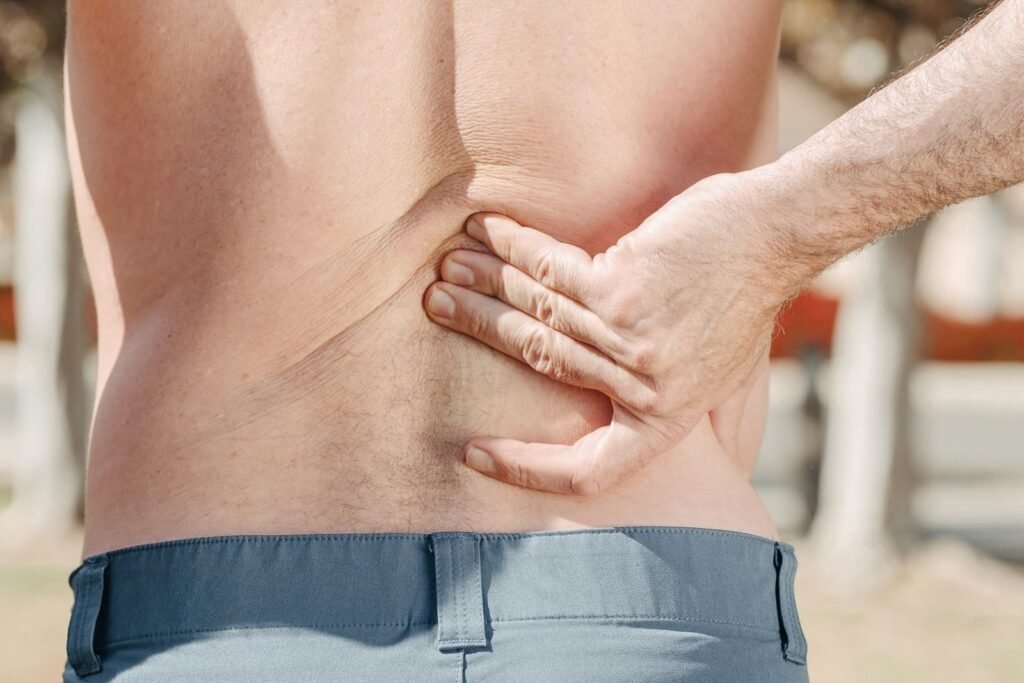
A slipped disc, also called a herniated or prolapsed disc, usually gets better without surgery. The soft centre of a spinal disc pushes out through its tougher outer layer and can irritate a nearby nerve, causing back pain and sometimes pain down the leg (sciatica). Research shows the herniated part often shrinks on its own over time, and in a large trial of people with severe sciatica, 95% reported recovery after one year whether or not they had early surgery. Staying active, a guided exercise plan and time are the usual first steps. A few warning signs need urgent medical care.
The short version
- A disc doesn’t actually slip. The jelly-like centre pushes through the outer ring and can press on or inflame a nerve.
- Most improve without surgery. A review of 31 studies found the herniated part often shrinks over time, and the larger the herniation, the more likely it was to regress.
- Scans can mislead. Disc bulges and protrusions are common in people with no pain at all, so an MRI isn’t routinely needed.
- Surgery speeds relief, not the end result. In a trial of 283 people, early surgery eased leg pain faster, but outcomes at one year were similar.
- Some symptoms are an emergency. New bladder or bowel problems, or numbness around the groin, need same-day care.
What is a slipped disc?
Between each bone in your spine sits a disc that works like a shock absorber. It has a tough outer ring and a softer, gel-like centre. When part of that centre pushes out through a weak point in the ring, it’s called a disc herniation. Most happen in the lower back.
The disc itself isn’t always the source of pain. Symptoms often come from the nearby nerve root, which can be squeezed or irritated by the inflammation the herniated material causes. That’s why a slipped disc can cause pain, tingling or numbness that travels down the buttock and leg, often below the knee. Our guide to sciatica or lower back pain explains how to tell the two apart.
Symptoms of a slipped disc
- Lower back pain, often worse with sitting, bending or coughing
- Pain that travels down one leg, sometimes into the foot
- Pins and needles or numbness in the leg or foot
- Weakness in the leg or foot in some cases
- Stiffness and difficulty finding a comfortable position
Leg pain is often worse than the back pain itself. Symptoms usually come on over hours or days, sometimes after lifting or bending, and sometimes with no clear trigger.
Can a slipped disc heal on its own?
Often, yes. A systematic review of 31 studies followed people with lumbar disc herniation who were treated without surgery and had repeat scans. How often the herniation shrank depended on its type:1
| Type of herniation | What it means | How often it shrank |
|---|---|---|
| Bulge | The disc spreads out evenly beyond its normal edge | 13% |
| Protrusion | A small section pushes out, still contained | 41% |
| Extrusion | Disc material breaks through the outer ring | 70% |
| Sequestration | A fragment separates from the disc | 96% |
It may seem surprising that larger herniations shrink more often. One explanation is that the body’s immune response gradually clears away disc material that has broken free. The herniation fully disappeared in 43% of sequestrated discs and 15% of extruded discs.
How long does a slipped disc take to recover?
For many people, symptoms ease over a few weeks to a few months. In the Sciatica trial, published in the New England Journal of Medicine, 283 people with severe sciatica from a disc herniation were randomly assigned to early surgery or to prolonged non-surgical care, with surgery if needed:2
- Leg pain eased faster in the early surgery group.
- After one year, outcomes were similar in both groups, and 95% of people in each group reported recovery.
- In the non-surgical group, 39% eventually had surgery, on average about 19 weeks in.
So surgery can be the right choice for some people, especially when leg pain is severe and not settling, but it mainly changes how quickly pain eases rather than where most people end up a year later.
Do you need an MRI?
Usually not at first. The UK’s National Institute for Health and Care Excellence (NICE) advises against routinely offering imaging for low back pain, with or without sciatica, in non-specialist settings.3 One reason is that scans often show changes in people who have no pain. A review of 33 studies covering 3,110 people without back pain found disc protrusions in 29% of 20-year-olds, rising to 43% of 80-year-olds, and disc bulges in 30% of 20-year-olds, rising to 84% of 80-year-olds.4
A scan becomes useful when its result would change the plan: for example, when surgery is being considered, when symptoms aren’t improving as expected, or when there are signs of a more serious problem.
What helps a slipped disc?
Keep moving, within comfort
Gentle activity usually helps more than rest. Short walks, changing position often and avoiding long periods of sitting can all ease symptoms. Pain that spreads further down the leg is a sign to ease off that activity for now.
A guided exercise plan
NICE suggests considering a group exercise programme for low back pain with or without sciatica, and advises that hands-on manual therapy be used only as part of a package that includes exercise.3 A review of five trials in people with sciatica found exercise gave a small extra short-term benefit for leg pain over advice to stay active, though the evidence was low quality and the difference didn’t last at longer follow-up.5 In practice, exercise is most useful for rebuilding confidence and strength once the worst pain settles. Our guide to exercises for lower back pain covers what the research supports.
Pain relief
Ask a doctor or pharmacist which medicines are suitable for you. Taking the edge off pain can make it easier to stay active and sleep.
When surgery is considered
NICE suggests considering spinal decompression surgery for sciatica when non-surgical treatment hasn’t improved pain or function and scan findings match the symptoms.3 This is a decision to make with a spinal specialist.
Easing a flare at home
- Find a position of ease: many people are more comfortable lying on their back with knees bent, or on their side with a pillow between the knees.
- Move little and often: get up and walk for a few minutes every 30 to 60 minutes rather than sitting for long stretches.
- Watch the leg symptoms: if pain moves further down the leg during an activity, ease off. If it moves back towards the back, that’s usually a good sign.
- Sleep: support your body with pillows so you can stay in one position comfortably.
How physiotherapy helps
A physiotherapist will check your strength, reflexes and sensation to see how much the nerve is affected, rule out warning signs, and find positions and movements that ease your symptoms. From there, the plan usually includes graded exercise, advice on sitting, lifting and sleep, hands-on treatment where it helps, and a plan for flare-ups. If anything suggests you need a scan or a specialist opinion, you’ll be referred. Read more about our back pain treatment in Dubai.
Get emergency care (call 998 in the UAE) if you have
- New difficulty passing urine, or loss of bladder or bowel control
- Numbness around the groin, buttocks or genitals
- Weakness in one or both legs that is getting worse
- Severe back pain with fever, or after a fall or accident
These can be signs of cauda equina syndrome or another serious problem. See our guide to back pain red flags for more.
Frequently asked questions
Can a slipped disc heal on its own?
Often, yes. A review of 31 studies found the herniated part of the disc shrank over time in many people treated without surgery, most often in larger herniations: 70% of extrusions and 96% of sequestrations.
How long does a slipped disc take to heal?
Many people improve over a few weeks to a few months. In a trial of 283 people with severe sciatica from a disc herniation, 95% reported recovery after one year, whether they had early surgery or non-surgical care first.
Do I need an MRI for a slipped disc?
Usually not at first. Guidelines advise against routine imaging because disc bulges and protrusions are common in people without pain. A scan is useful when surgery is being considered, symptoms aren’t improving, or there are warning signs.
Should I rest or keep moving with a slipped disc?
Keep moving within comfort. Gentle walking and changing position often usually help more than bed rest. Ease off any activity that sends pain further down the leg.
When is surgery needed for a slipped disc?
Surgery is considered when severe leg pain isn’t improving with non-surgical care and scans match the symptoms, or urgently if there are signs of nerve damage such as bladder problems or worsening leg weakness. Early surgery eases leg pain faster, but one-year outcomes are similar.
References
- Chiu CC, Chuang TY, Chang KH, Wu CH, Lin PW, Hsu WY. The probability of spontaneous regression of lumbar herniated disc: a systematic review. Clin Rehabil. 2015;29(2):184-195.
- Peul WC, van Houwelingen HC, van den Hout WB, et al. Surgery versus prolonged conservative treatment for sciatica. N Engl J Med. 2007;356(22):2245-2256.
- National Institute for Health and Care Excellence. Low back pain and sciatica in over 16s: assessment and management (NG59). London: NICE; 2016, updated 2020.
- Brinjikji W, Luetmer PH, Comstock B, et al. Systematic literature review of imaging features of spinal degeneration in asymptomatic populations. AJNR Am J Neuroradiol. 2015;36(4):811-816.
- Fernandez M, Hartvigsen J, Ferreira ML, et al. Advice to stay active or structured exercise in the management of sciatica: a systematic review and meta-analysis. Spine. 2015;40(18):1457-1466.

About Somatic Recovery
Somatic Recovery is the Dubai practice of Shubhangii Gaikwaad, DHA-Licensed Physiotherapist (MPT, Neurology) with 16 years of clinical experience. Sessions in person in Dubai and online worldwide, in English and Hindi.
This article is general information, not a diagnosis or a substitute for an individual assessment. If you have severe, sudden or worsening symptoms, see a doctor.
Somatic Recovery · Dubai & online
Want this looked at properly?
One assessment with a DHA-licensed physiotherapist to understand what is driving your symptoms, with a clear plan and an honest timeline.
Keep reading
 Back PainLower Back Pain When Bending Forward: Causes and What HelpsBending isn't the enemy. Why your back hurts when you bend, what scans really show, and how to get comfortable bending again.8 min read→
 Back PainIs Walking Good for Back Pain? What the Research SaysOne of the simplest things you can do for your back. How much walking helps, how to build up, and what the WalkBack trial found.6 min read→
 Back PainWhy Is My Back Stiff in the Morning? Causes and What HelpsUsually it is your spine waking up, not damage. Why it happens, a 3-minute routine before you get up, and the pattern worth checking.7 min read→