Balance After 40: Why It Matters for Longevity and How to Train It
Balance starts slipping earlier than most people think. Here's how it changes with age, why it matters, and how to train it in a few minutes a day.
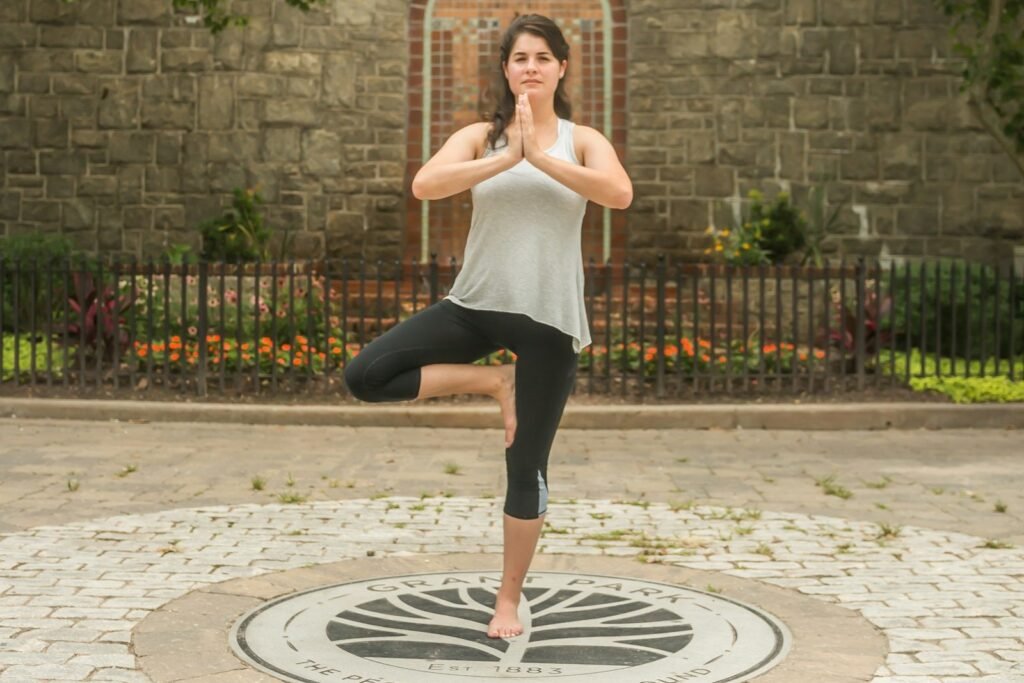
Balance starts to decline earlier than most people expect. In healthy adults, the time people can stand on one leg drops steadily from their 40s, and the fall becomes steep after 60, especially with the eyes closed. That matters because balance is closely tied to falls, and in middle-aged and older adults, being unable to stand on one leg for 10 seconds has been linked to a higher risk of death. The good news is that balance responds well to training. Exercise that includes balance work reduces falls in older adults by about a quarter, and studies suggest around three short sessions a week for about three months is enough to see real gains.
The short version
- Balance declines with age, faster after 60. In a study of 549 healthy adults, average one-leg balance with eyes closed fell from about 13 seconds in the 40s to about 4 to 5 seconds in the 60s.
- It’s linked to bigger outcomes. In 1,702 adults aged 51 to 75, those who couldn’t hold a 10-second one-leg stand were more likely to die over the next 7 years.
- Exercise prevents falls. A Cochrane review of 108 trials found exercise reduced the rate of falls in older adults by 23%.
- Balance is trainable. Training about three times a week for 11 to 12 weeks gave the biggest improvements in one review.
- Start before you need it. Your 40s and 50s are a good time to build the habit, while balance is still easy to improve.
Why does balance get worse with age?
Balance is not one skill. It depends on several systems working together:
- Vision, which tells you where you are in the room
- The inner ear, which senses head movement and gravity
- Body sense from the feet, ankles and joints, which tells your brain where your body is
- Muscle strength and reaction speed, which let you correct a wobble before it becomes a fall
Each of these tends to change gradually with age. Leg strength falls, reactions slow a little, and the feet and ankles send less precise signals. Most people don’t notice for years, because the systems cover for each other. Closing your eyes takes away one of them, which is why balance with the eyes closed shows the decline much earlier.
Inactivity speeds it up. If you rarely stand on one leg, step over things, or move on uneven ground, the body has less reason to keep those skills sharp.
How long should you be able to stand on one leg?
A study of 549 healthy adults measured how long people could stand on one leg, taking the best of three tries, with a maximum of 45 seconds.1 Times dropped steadily with age:
| Age | Eyes open (average) | Eyes closed (average) |
|---|---|---|
| 18 to 39 | 44 to 45 seconds | 13 to 17 seconds |
| 40 to 49 | about 42 seconds | 12 to 14 seconds |
| 50 to 59 | about 41 seconds | 8 to 9 seconds |
| 60 to 69 | 30 to 34 seconds | 4 to 5 seconds |
| 70 to 79 | 17 to 26 seconds | about 3 to 4 seconds |
| 80 and over | 9 to 11 seconds | about 2 seconds |
Ranges show the averages for women and men, which were similar. These are averages, not pass marks, and individual results vary a lot. Eyes-closed balance drops by about a third between the 40s and 50s, then roughly halves again by the 60s.
A separate study followed 1,702 adults aged 51 to 75 for a median of 7 years. About one in five couldn’t stand on one leg for 10 seconds. In that group, 17.5% died during follow-up, compared with 4.6% of those who could.2 This shows a link, not proof that poor balance causes death, but it suggests balance is a useful signal of overall health. Our article on mobility and longevity explains how to do the 10-second test safely at home.
Why balance matters: falls
Falls are the most direct reason to care about balance. At least one in three people over 65 living at home falls each year.3 Falls can cause fractures and loss of confidence, and many people start moving less afterwards, which weakens balance further.
Exercise breaks that cycle. A Cochrane review of 108 trials with more than 23,000 people aged 60 and over found:3
- Exercise reduced the rate of falls by 23% (high-certainty evidence).
- It reduced the number of people who had one or more falls by 15% (high-certainty evidence).
- Programmes built mainly on balance and functional exercises cut the rate of falls by 24% (high-certainty evidence).
- Combining balance work with strength exercises probably cut it by about a third (moderate-certainty evidence).
Most of the people in these trials were in their 70s. That’s a reason to start earlier, not later: balance is easier to build and keep in your 40s and 50s than to rebuild after a fall.
How to train your balance
How much is enough?
A review of balance training in healthy older adults found it improved every type of balance measured, from standing still to reacting to a push.4 The programmes that worked best had these features:
- About three sessions a week
- For 11 to 12 weeks (36 to 40 sessions in total)
- Sessions of 31 to 45 minutes, adding up to 91 to 120 minutes a week
You don’t need a gym. Short balance drills can also be built into daily life, and they add up.
A simple balance progression
- One-leg stand with support: stand next to a counter, lift one foot, hold 20 to 30 seconds each side. Use a fingertip for support if needed.
- One-leg stand without support: the same, hands free. Build to 30 seconds each side.
- Heel-to-toe walk: walk 10 steps placing one heel directly in front of the other toes, along a wall.
- Add movement: on one leg, slowly turn your head side to side, or reach your arms in different directions.
- Take away vision: one-leg stand with eyes closed for a few seconds at a time, always beside a counter.
- Challenge the surface: stand on a folded towel or cushion to make the feet and ankles work harder.
Move to the next step only when the current one feels steady. Always practise near something you can hold, and stop if you feel dizzy.
Add strength work
Strong legs and hips make it easier to catch yourself. Squats to a chair, step-ups, calf raises and side-lying leg lifts, done two or three times a week, support your balance practice. Our guide to strength training for longevity has a simple twice-a-week routine.
Build it into your day
- Stand on one leg while brushing your teeth or waiting for the kettle.
- Walk on grass, sand or uneven paths when you can.
- Try activities that challenge balance, such as tai chi, yoga or Pilates. Tai chi has also been linked to fewer falls in older adults.
When to see a physiotherapist
It’s worth getting your balance assessed if you’ve had a fall or a near miss, if you feel unsteady on stairs or uneven ground, if you’ve noticed your balance getting worse, or if an injury or joint problem is holding you back. A physiotherapist can test strength, joint movement and the different parts of your balance system, find what is limiting you, and build a safe, progressive plan. You can read how we work on our physiotherapy in Dubai page.
See a doctor first if you have
- Dizziness or a spinning sensation (vertigo), especially if it’s new
- Sudden loss of balance, weakness or numbness on one side, slurred speech or a drooping face. In the UAE, call 998 immediately
- Repeated falls without a clear reason
- Fainting or near-fainting when you stand up
- New hearing loss or ringing in the ears with balance problems
Frequently asked questions
At what age does balance start to decline?
Gradually from middle age. In a study of 549 healthy adults, one-leg balance with eyes closed was already lower in people in their 50s than in their 40s, and it dropped sharply after 60. With eyes open, the bigger drop came after 60.
How long should a 50-year-old be able to stand on one leg?
In a study of healthy adults, people aged 50 to 59 averaged about 41 seconds with eyes open (out of a maximum of 45) and about 8 to 9 seconds with eyes closed. These are averages, not targets, and results vary widely between individuals.
Can you improve balance after 40?
Yes. Balance responds well to training at any age. A review of studies in older adults found that about three balance sessions a week for 11 to 12 weeks gave the biggest improvements.
What is the best exercise for balance?
No single exercise is best. A mix works well: one-leg standing, heel-to-toe walking, movements that add head turns or reaches, and leg strengthening. Tai chi and yoga also challenge balance in useful ways.
Does exercise really prevent falls?
Yes, in older adults. A Cochrane review of 108 trials found exercise reduced the rate of falls by 23% in people aged 60 and over living at home, with high-certainty evidence.
References
- Springer BA, Marin R, Cyhan T, Roberts H, Gill NW. Normative values for the unipedal stance test with eyes open and closed. J Geriatr Phys Ther. 2007;30(1):8-15.
- Araujo CG, de Souza e Silva CG, Laukkanen JA, et al. Successful 10-second one-legged stance performance predicts survival in middle-aged and older individuals. Br J Sports Med. 2022;56(17):975-980.
- Sherrington C, Fairhall NJ, Wallbank GK, et al. Exercise for preventing falls in older people living in the community. Cochrane Database Syst Rev. 2019;1(1):CD012424.
- Lesinski M, Hortobágyi T, Muehlbauer T, Gollhofer A, Granacher U. Effects of balance training on balance performance in healthy older adults: a systematic review and meta-analysis. Sports Med. 2015;45(12):1721-1738.

About Somatic Recovery
Somatic Recovery is the Dubai practice of Shubhangii Gaikwaad, DHA-Licensed Physiotherapist (MPT, Neurology) with 16 years of clinical experience. Sessions in person in Dubai and online worldwide, in English and Hindi.
This article is general information, not a diagnosis or a substitute for an individual assessment. If you have severe, sudden or worsening symptoms, see a doctor.
Somatic Recovery · Dubai & online
Want this looked at properly?
One assessment with a DHA-licensed physiotherapist to understand what is driving your symptoms, with a clear plan and an honest timeline.
Keep reading
 Recovery & ResetStrength Training for Longevity: How Much Is Enough?About an hour a week, split over two sessions, is where the research shows the biggest payoff. Here's what that looks like and how to start.8 min read→
 Recovery & ResetMobility and Longevity: 4 Simple Movement Tests Linked to Healthy AgeingGetting up off the floor, standing on one leg, grip and walking pace: four quick tests linked to healthy ageing, and how to train each one.7 min read→
 PhysiotherapyKnee Pain on Stairs: Causes and What HelpsSteps hurt, especially going down? Why stairs load the kneecap, the usual causes, and how hip and knee strength helps.6 min read→