Knee Pain on Stairs: Causes and What Helps
Steps hurt, especially going down? Why stairs load the kneecap, the usual causes, and how hip and knee strength helps.
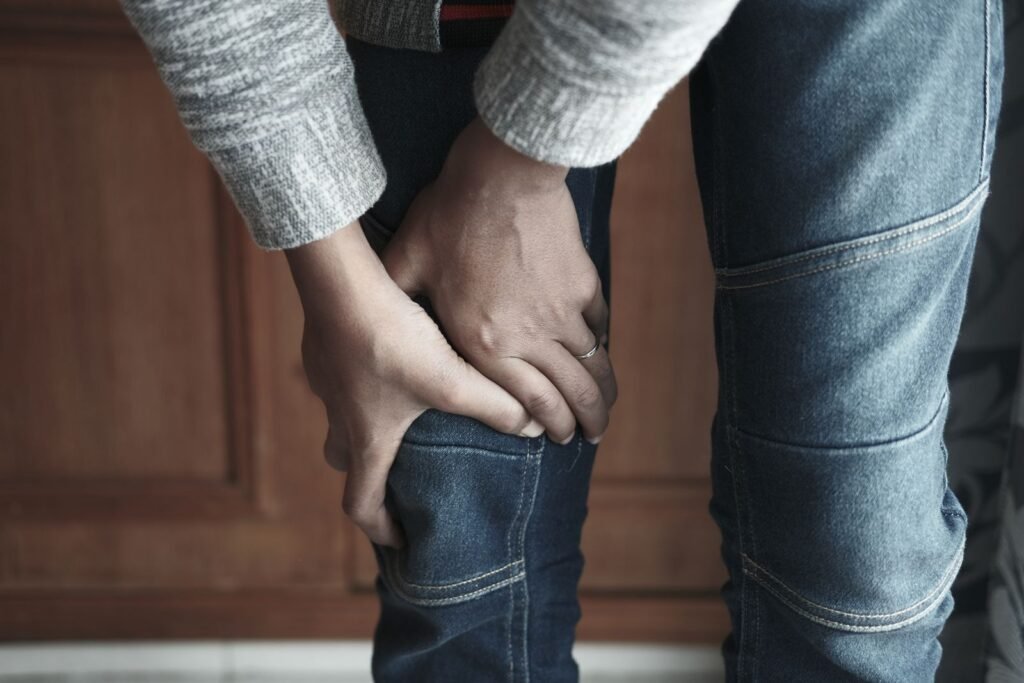
Knee pain on stairs is usually felt at the front of the knee, around or behind the kneecap, and is often worse going down than going up. In younger and active adults the most common cause is patellofemoral pain, a sensitive kneecap joint that reacts to bending under load. In people over about 45, knee osteoarthritis is another common cause. Both usually respond well to exercise: an international expert consensus recommends exercise therapy, especially combining hip and knee strengthening, as the main treatment for patellofemoral pain, and NICE recommends exercise as a core treatment for osteoarthritis. Rest alone rarely fixes it. Sudden swelling, locking or a knee that gives way needs checking.
The short version
- It’s very common. A review of 23 studies estimated that about 1 in 5 people in the general population has kneecap pain over a year.
- Stairs load the kneecap. Bending the knee while carrying your body weight presses the kneecap into the thigh bone, which is why steps hurt.
- Hip and knee exercise works best. Experts recommend combining hip and knee strengthening over knee exercises alone.
- Osteoarthritis also responds to exercise. NICE recommends tailored exercise as a core treatment for knee osteoarthritis.
- Know the warning signs. Rapid swelling, locking, giving way or a hot, red knee need prompt medical advice.
Why does my knee hurt on stairs?
Every step up or down asks your knee to bend while it carries your whole body weight. That presses the kneecap into its groove at the end of the thigh bone. If the joint behind the kneecap, or the tissues around it, have become sensitive, that pressure is felt as pain.
Going down is often worse than going up. On the way down, the thigh muscles work while lengthening to control the movement, and the knee takes more load as you lower yourself onto the step below.
Common causes of knee pain on stairs
| Patellofemoral pain | Knee osteoarthritis | Patellar tendinopathy | |
|---|---|---|---|
| Who it affects | Teens and adults, often active | Mostly people over 45 | People who jump, run or squat a lot |
| Where it hurts | Around or behind the kneecap | Inside, front or whole knee | Just below the kneecap |
| Other signs | Pain sitting with knees bent, squatting, kneeling | Morning stiffness under 30 minutes, creaking, sometimes swelling | Pain when jumping or landing, warms up then returns |
| First-line treatment | Hip and knee exercise | Exercise and weight management | Progressive tendon loading |
Patellofemoral pain
Patellofemoral pain is one of the most common causes of knee pain. A 2018 review of 23 studies reported an annual prevalence of 22.7% in the general population and 28.9% in adolescents.1 It typically hurts on stairs, squatting, kneeling, running and after sitting for a long time with the knees bent, sometimes called the “cinema sign”.
Knee osteoarthritis
Osteoarthritis is a change in the joint that becomes more common with age. NICE suggests it can be diagnosed without an X-ray in people aged 45 or over with activity-related joint pain and either no morning stiffness or stiffness lasting no longer than 30 minutes.2 Stairs are often one of the first activities to become difficult.
What helps knee pain on stairs?
Exercise, including the hips
An international consensus statement on patellofemoral pain recommends exercise therapy to reduce pain and improve function in the short, medium and long term. It specifically recommends combining hip and knee exercises over knee exercises alone.3 Strong hip muscles help control how the thigh and knee line up as you step, which can ease the load on the kneecap.
For knee osteoarthritis, NICE recommends offering therapeutic exercise tailored to the person, such as local muscle strengthening and general aerobic fitness, alongside information and support with weight loss where relevant.2
Adjust the load for a while
You don’t need to avoid stairs completely. For a few weeks, it can help to take stairs one at a time, use the rail, lead with the stronger leg going up and the sore leg going down, and cut back on deep squats and kneeling while you build strength.
Two starting exercises for stair pain
- Side-lying leg lift: lie on your side with your bottom knee bent. Keep the top leg straight and slightly behind you, and lift it about 30 cm, leading with the heel. Lower slowly. Do 10 to 15, then swap sides.
- Wall sit: stand with your back against a wall and slide down only as far as feels comfortable, with knees over your feet. Hold for 15 to 30 seconds, rest, and repeat 4 times.
- Build up slowly: do these every other day. Mild discomfort that settles within 24 hours is fine.
Stop and get advice if exercise causes sharp pain, swelling or your knee feels unstable.
Stay active overall
Walking, cycling and swimming keep the knee and the rest of the body moving while you work on strength. Our guide to strength training for longevity covers how to build strength safely as you get older, and balance after 40 explains why balance matters for stairs too.
When to see a physiotherapist
See a physiotherapist if knee pain on stairs has lasted more than a few weeks, keeps coming back, is stopping you from exercising or working, or if you’re not sure what’s causing it. A physiotherapist can work out whether the pain is coming from the kneecap joint, the tendon or the joint itself, and look at how your hips, feet and movement patterns affect the knee.
How physiotherapy at Somatic Recovery helps
Shubhangii Gaikwaad, a DHA-licensed physiotherapist, will ask about your symptoms and activity, watch how you step, squat and balance, test your hip and thigh strength, and check for signs that need a doctor or a scan. Treatment usually centres on a progressive hip and knee strengthening programme, with hands-on treatment and taping where they help, and practical advice so you can keep moving while the knee settles. Read more about our physiotherapy in Dubai or what happens at your first physiotherapy session.
Get prompt medical advice for knee pain with
- Swelling that comes on quickly after an injury, or a twist with a pop
- A knee that locks, catches and won’t straighten, or gives way
- A hot, red, swollen knee, especially with fever: get urgent care
- Calf pain and swelling, especially after a long flight or surgery: get urgent care
In an emergency in the UAE, call 998.
Frequently asked questions
Why do my knees hurt going down stairs?
Going down stairs bends the knee under load while the thigh muscles work to control the movement, which presses the kneecap into the thigh bone. If the kneecap joint is sensitive, as in patellofemoral pain, or the joint has osteoarthritis, this is often painful.
Should I avoid stairs if my knee hurts?
Not completely. Take them one at a time and use the rail while you build strength. Avoiding stairs altogether can make the knee weaker and more sensitive over time.
What exercises help knee pain on stairs?
Hip and knee strengthening exercises, such as side-lying leg lifts, wall sits and step-ups, are recommended for kneecap pain. A physiotherapist can choose and progress the right ones for you.
Is knee pain on stairs a sign of arthritis?
It can be, especially if you’re over 45 and have short morning stiffness. In younger people it’s more often patellofemoral pain. Both usually improve with exercise.
When should I see a doctor for knee pain?
See a doctor promptly for rapid swelling after an injury, a knee that locks or gives way, or a hot, red, swollen knee with fever. In an emergency in the UAE, call 998.
References
- Smith BE, Selfe J, Thacker D, et al. Incidence and prevalence of patellofemoral pain: a systematic review and meta-analysis. PLoS One. 2018;13(1):e0190892.
- National Institute for Health and Care Excellence. Osteoarthritis in over 16s: diagnosis and management (NG226). NICE guideline.
- Crossley KM, van Middelkoop M, Callaghan MJ, et al. 2016 Patellofemoral pain consensus statement from the 4th International Patellofemoral Pain Research Retreat, Manchester. Part 2: recommended physical interventions. Br J Sports Med. 2016;50(14):844-852.

About Somatic Recovery
Somatic Recovery is the Dubai practice of Shubhangii Gaikwaad, DHA-Licensed Physiotherapist (MPT, Neurology) with 16 years of clinical experience. Sessions in person in Dubai and online worldwide, in English and Hindi.
This article is general information, not a diagnosis or a substitute for an individual assessment. If you have severe, sudden or worsening symptoms, see a doctor.
Somatic Recovery · Dubai & online
Want this looked at properly?
One assessment with a DHA-licensed physiotherapist to understand what is driving your symptoms, with a clear plan and an honest timeline.
Keep reading
 PhysiotherapyRotator Cuff Pain: Symptoms, Causes and What HelpsShoulder hurts when you lift your arm? What rotator cuff pain is, why exercise comes first, and when to see a doctor.7 min read→
 PhysiotherapyHeadaches From the Neck: Cervicogenic Headache ExplainedWhen the headache starts in your neck. How to spot a cervicogenic headache and why neck exercises help.6 min read→
 PhysiotherapyFrozen Shoulder: Symptoms, Stages and What Actually HelpsPainful, stiff and slow to settle. What frozen shoulder is, how long it lasts, and why early injection plus exercise has the best evidence.7 min read→