Mobility and Longevity: 4 Simple Movement Tests Linked to Healthy Ageing
Getting up off the floor, standing on one leg, grip and walking pace: four quick tests linked to healthy ageing, and how to train each one.
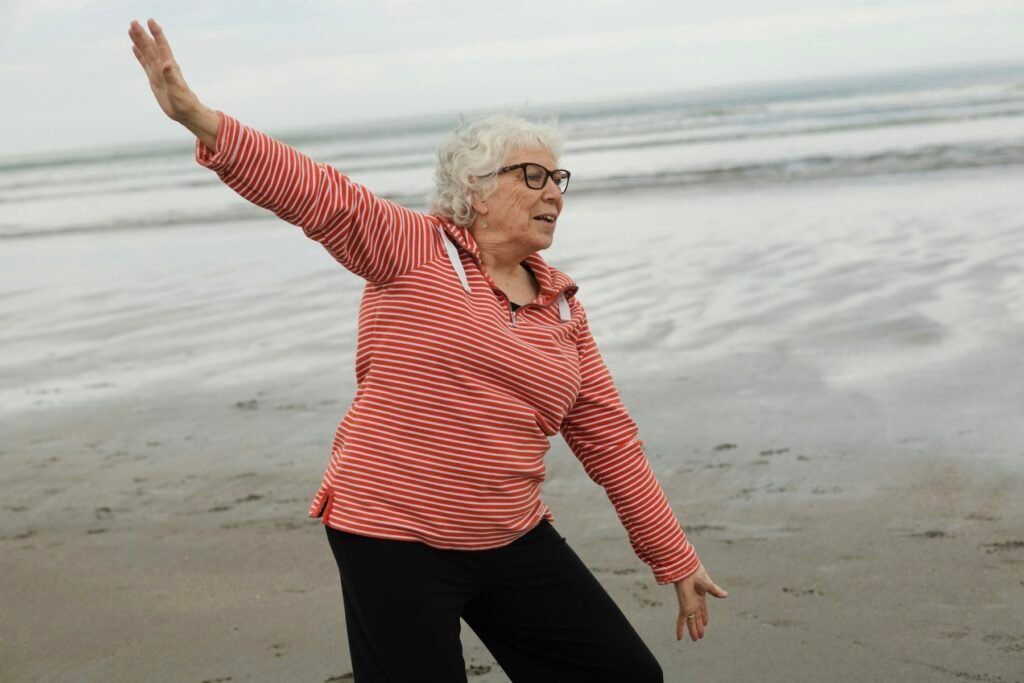
How well you move is one of the clearest signs of how well you’re ageing. Large studies have found that simple movement tests, like getting up off the floor, standing on one leg, gripping firmly and walking at a steady pace, are linked to longer survival in middle and later life. These tests don’t predict your future on their own, and the research shows a link rather than proof that improving your score adds years. But they are quick, free ways to see where your strength, balance and mobility stand, and all four are trainable at almost any age.
The short version
- Movement is a longevity marker. Strength, balance and walking speed are each linked to survival in large studies of adults.
- Four simple tests give a useful snapshot: sit-to-rise from the floor, 10-second one-leg stand, grip strength and walking pace.
- A link, not a guarantee. The studies show association. They don’t prove that changing your score changes your lifespan.
- All four can be trained with regular strength, balance and walking practice.
- Test safely. Skip any test that feels risky for you, and get advice first if you have balance problems, joint replacements or recent injuries.
Why mobility matters for longevity
Most conversations about longevity focus on blood tests, diet and sleep. Movement often gets left out, yet it underpins almost everything you do: getting out of a chair, climbing stairs, carrying shopping, catching yourself if you trip. Muscle strength and balance naturally decline from midlife onwards, and that decline is one of the reasons everyday tasks get harder and falls become more likely with age.
The encouraging part is that strength, balance and mobility respond to training at any age. That makes them some of the most practical “longevity markers” you can work on, with benefits you can feel day to day, not just in the long run.
Test 1: Sit to the floor and stand back up
What it shows: leg strength, flexibility, balance and coordination together.
In the sitting-rising test, you lower yourself to sit cross-legged on the floor and then stand back up, using as little support as possible. You start with 5 points for sitting and 5 for rising, and lose a point each time you use a hand, knee, forearm or the side of your leg for support.
A study of 2,002 adults aged 51 to 80 found that lower scores were associated with higher mortality over about six years of follow-up. The authors concluded that this simple test adds useful information about functional ability in general health checks.1
How to practise: sit-to-stand from a chair without using your hands, then lower the seat height over time. Hip and ankle mobility work and controlled squats also help.
Test 2: Stand on one leg for 10 seconds
What it shows: static balance, which is closely tied to fall risk.
Stand barefoot on one leg, with the other foot resting on the back of your standing leg, arms by your sides and eyes looking ahead. Try to hold for 10 seconds. Do this next to a wall or kitchen counter you can grab if needed.
In a study of 1,702 people aged 51 to 75, about 1 in 5 couldn’t complete the 10-second stand. Over a median of seven years, 17.5% of those who couldn’t do it died, compared with 4.6% of those who could, and the test added prognostic information beyond age and other health measures.2
How to practise: stand on one leg while brushing your teeth or waiting for the kettle, holding onto the counter at first. Progress by letting go, then by turning your head slowly or closing your eyes briefly, always with support close by. For average one-leg times by age and a full progression, see our guide to balance after 40.
Test 3: Grip strength
What it shows: overall muscle strength. Grip is easy to measure and reflects strength across the body.
The PURE study measured grip strength in nearly 140,000 adults in 17 countries. Each 5 kg reduction in grip strength was associated with a 16% higher risk of death from any cause over about four years, and grip strength predicted mortality better than blood pressure did.3 The authors noted that more research is needed to test whether building strength reduces this risk.
Grip is usually measured with a handheld dynamometer, which many physiotherapy clinics have. At home, a rough guide is whether you can carry heavy shopping bags comfortably or hang briefly from a bar.
How to practise: carrying weights (holding a heavy bag in each hand and walking), dead hangs if appropriate, and general strength training for the whole body. Grip tends to improve as overall strength does.
Test 4: Your everyday walking pace
What it shows: how well many body systems work together, including muscles, joints, heart, lungs and balance.
A pooled analysis of nine studies covering more than 34,000 older adults found that faster usual walking speed was associated with longer survival. Each 0.1 metre per second increase in gait speed was linked to a lower risk of death.4
To check yours, mark out a short, flat distance and time yourself walking it at your normal pace, not as fast as you can. Repeat it every few months to see the trend.
How to practise: regular brisk walking, plus leg strengthening such as step-ups and sit-to-stands. Breaking up long periods of sitting also helps; our guide to lower back pain from sitting all day has a simple desk routine.
Before you try these tests
- Skip the floor and balance tests if you have frequent falls, dizziness, a recent fracture or injury, or a hip or knee replacement, unless a health professional has said it’s safe.
- Always test next to something sturdy you can hold.
- Stop if anything causes sharp pain.
- A low score is a reason to start working on that area, not a diagnosis. Talk to your doctor if you notice a sudden change in balance or strength.
What these tests can and can’t tell you
These studies are observational. They show that people who score better tend to live longer, but they can’t fully separate movement from everything else that affects health, such as illness, activity levels and other lifestyle factors. Improving your score is worthwhile for strength, independence and lower fall risk in its own right, but no one can promise it will add a specific number of years.
Used sensibly, the tests are a useful baseline. Repeating them every few months shows whether your training is working, and a big drop can be a prompt to look more closely at what’s changed.
Building a longevity-focused movement routine
You don’t need a complicated programme. For most adults, a balanced week includes:
- Strength training for the major muscle groups on at least two days a week (see how much strength training is enough)
- Balance practice for a few minutes most days, such as single-leg standing and heel-to-toe walking
- Regular walking or other activity that gets you slightly out of breath
- Mobility work for hips, ankles and the upper back, to keep everyday movements easy
- Recovery: enough sleep and rest days so your body can adapt to the work
A 10-minute daily starter
- Chair sit-to-stands without hands: 2 sets of 8 to 10
- Single-leg stand next to a counter: 3 × 20 seconds each side
- Heel-to-toe walk along a hallway: 3 lengths
- Wall push-ups: 2 sets of 10
- Brisk 5-minute walk
Adjust the numbers to what feels challenging but controlled. If any exercise causes pain, stop and get advice.
If pain, stiffness or an old injury stops you from training the way you’d like, a physiotherapy assessment can help you work around it and build a plan that fits your body. You can read about our approach on our physiotherapy in Dubai page, or see how strength, regulation and recovery fit together in our Recovery & Reset programme.
Frequently asked questions
What is the sitting-rising test?
It’s a simple test where you sit down on the floor and stand back up using as little support as possible. You start with 10 points and lose one each time you use a hand, knee or other body part for support. In a study of adults aged 51 to 80, lower scores were linked to higher mortality.
How long should I be able to stand on one leg?
A common benchmark for adults in midlife and beyond is 10 seconds. In one study of people aged 51 to 75, those who couldn’t manage 10 seconds had a higher risk of death over the following years. Always practise next to something you can hold onto.
Can you improve your balance and strength after 50?
Yes. Strength and balance respond to regular training at any age. Even short, consistent sessions of strength work and balance practice can make a noticeable difference to everyday movement and confidence.
Does improving these test scores make you live longer?
The research shows a link between better scores and longer survival, not proof that improving your score extends life. Better strength and balance do bring clear practical benefits, including easier daily movement and a lower risk of falls.
Can a physiotherapist help with longevity training?
A physiotherapist can assess your strength, balance and mobility, take any pain or injuries into account, and design a safe, progressive programme. That’s especially useful if past injuries or pain are holding you back.
References
- Brito LB, Ricardo DR, Araújo DS, et al. Ability to sit and rise from the floor as a predictor of all-cause mortality. Eur J Prev Cardiol. 2014;21(7):892-898.
- Araujo CG, de Souza e Silva CG, Laukkanen JA, et al. Successful 10-second one-legged stance performance predicts survival in middle-aged and older individuals. Br J Sports Med. 2022;56(17):975-980.
- Leong DP, Teo KK, Rangarajan S, et al. Prognostic value of grip strength: findings from the Prospective Urban Rural Epidemiology (PURE) study. Lancet. 2015;386(9990):266-273.
- Studenski S, Perera S, Patel K, et al. Gait speed and survival in older adults. JAMA. 2011;305(1):50-58.

About Somatic Recovery
Somatic Recovery is the Dubai practice of Shubhangii Gaikwaad, DHA-Licensed Physiotherapist (MPT, Neurology) with 16 years of clinical experience. Sessions in person in Dubai and online worldwide, in English and Hindi.
This article is general information, not a diagnosis or a substitute for an individual assessment. If you have severe, sudden or worsening symptoms, see a doctor.
Somatic Recovery · Dubai & online
Want this looked at properly?
One assessment with a DHA-licensed physiotherapist to understand what is driving your symptoms, with a clear plan and an honest timeline.
Keep reading
 Recovery & ResetBalance After 40: Why It Matters for Longevity and How to Train ItBalance starts slipping earlier than most people think. Here's how it changes with age, why it matters, and how to train it in a few minutes a day.7 min read→
 Recovery & ResetStrength Training for Longevity: How Much Is Enough?About an hour a week, split over two sessions, is where the research shows the biggest payoff. Here's what that looks like and how to start.8 min read→
 PhysiotherapyRotator Cuff Pain: Symptoms, Causes and What HelpsShoulder hurts when you lift your arm? What rotator cuff pain is, why exercise comes first, and when to see a doctor.7 min read→